
TCM Journal
The TCM Organ Body Clock: A 12-Hour Meridian Wellness Guide
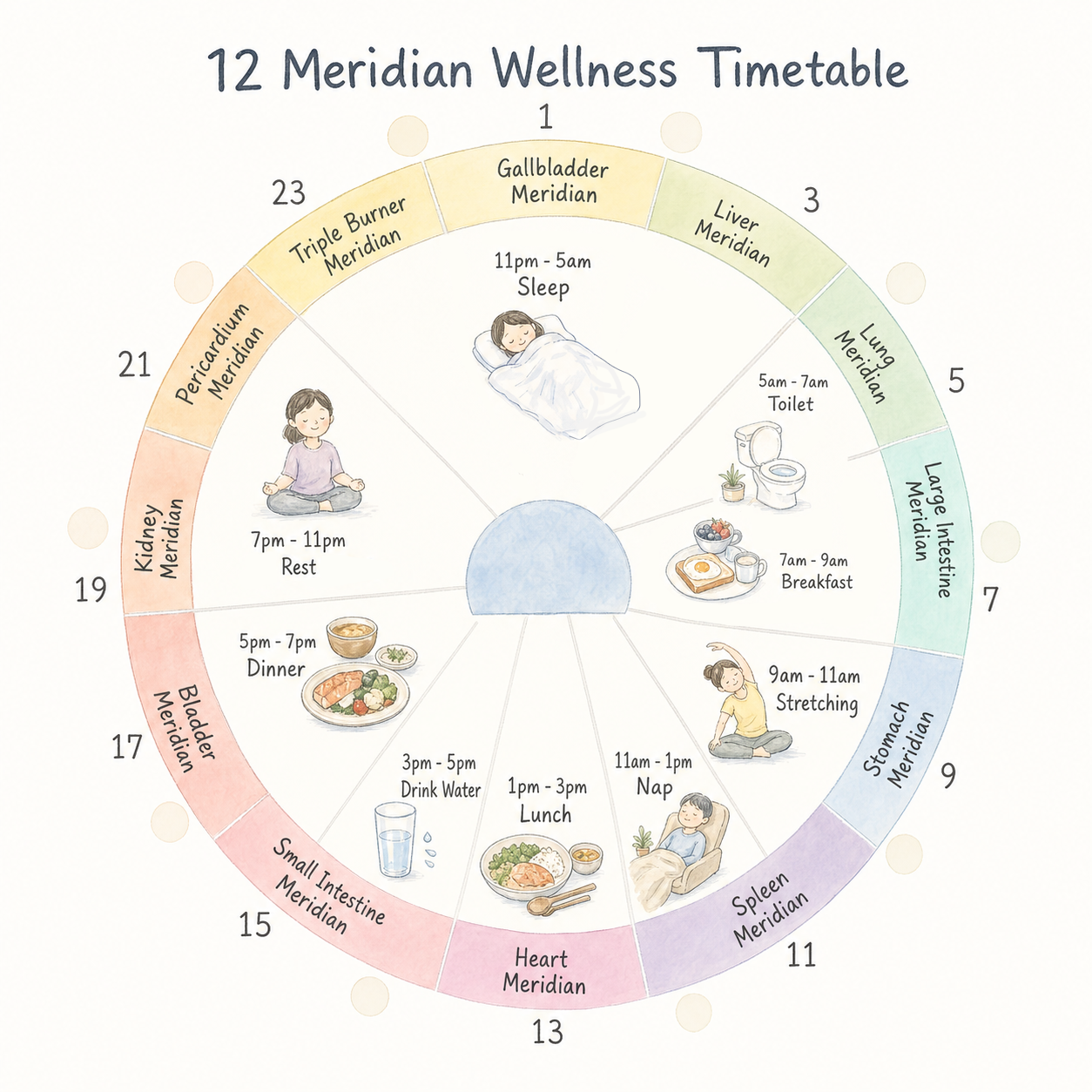
How the 12-hour meridian clock works
In Traditional Chinese Medicine, the Twelve Shi-Chen Wellness Method divides a full day into twelve two-hour intervals. Each interval corresponds to a specific meridian and its connected organ system. The idea is simple: when a meridian is at its peak, qi and blood are said to move most strongly through that channel, supporting a particular kind of repair, transformation, elimination, or activity.
This framework is often described through the Organ Body Clock. It is not a modern medical scan of organ function by the hour. It is a traditional rhythm model used to guide daily habits. For many readers, its value lies in helping them think more clearly about sleep timing, meals, bowel habits, energy peaks, and evening wind-down routines.
Below is the classic twelve-part cycle, moving from nighttime restoration into daytime activity and then back into evening conservation.
23:00 - 05:00: Nighttime restoration, repair, and detox
23:00 - 01:00 is Zi Shi, the Gallbladder meridian. The target organ is the gallbladder, and the wellness focus is simple: you should already be asleep. In TCM there is a saying that a clear gallbladder supports a clear mind. This period is traditionally linked with skin metabolism, gallbladder restoration, and marrow-related blood production. Getting into deep sleep before 23:00 is believed to support a clearer head and better recovery the next day.
01:00 - 03:00 is Chou Shi, the Liver meridian. The target organ is the liver, and the key focus is deep sleep. A classic TCM idea says that when a person lies down, blood returns to the liver. This is treated as the prime window for storing blood, repair, and detoxifying functions. Staying awake during these hours is traditionally associated with draining Liver Qi and leaving people more irritable, dry-eyed, and depleted.
03:00 - 05:00 is Yin Shi, the Lung meridian. The target organ is the lungs, and the ideal state is sound sleep while staying warm. TCM describes this period as the transition from stillness into movement, when qi and blood begin circulating more actively through the body again. People with weaker lung function are often said to cough more easily during these hours. It is also when body temperature is relatively low, so warmth and uninterrupted sleep are emphasized.
05:00 - 11:00: Morning awakening, elimination, and absorption
05:00 - 07:00 is Mao Shi, the Large Intestine meridian. The target organ is the large intestine, and the wellness focus is to wake up, drink warm water, and ideally have a bowel movement. In TCM this is when the body is best positioned to eliminate the previous day’s waste. A glass of warm water after waking is commonly recommended to stimulate bowel movement and encourage a regular morning routine.
07:00 - 09:00 is Chen Shi, the Stomach meridian. The target organ is the stomach, and this is considered the best time to eat a nourishing breakfast. TCM teaching says digestion and absorption are strongest here, making it the ideal window for a proper morning meal. Skipping breakfast is traditionally linked with weakening stomach function over time and contributing to low energy.
09:00 - 11:00 is Si Shi, the Spleen meridian. In TCM, the spleen is responsible for transforming food into usable nourishment and sending it through the body. This interval is often described as the first golden peak of the day, when the mind is clearest and energy is strongest. The wellness focus is steady work, clear concentration, and staying hydrated so qi and blood can circulate smoothly.
11:00 - 17:00: Afternoon balance, rest, and metabolism
11:00 - 13:00 is Wu Shi, the Heart meridian. The target organ is the heart, and the key wellness focus is lunch followed by a short rest. In TCM, noon and midnight are major turning points between yang and yin. A 15- to 30-minute rest, or even simply closing the eyes, is thought to nourish heart blood and help sustain stamina for the second half of the day. Sleeping too long, however, can interfere with nighttime rest.
13:00 - 15:00 is Wei Shi, the Small Intestine meridian. The target organ is the small intestine, which in TCM is said to separate the clear from the turbid. In practical terms, this is the time for absorbing what is useful from lunch while sending waste onward for elimination. Finishing lunch before 13:00 is often recommended so digestion can proceed efficiently during this interval.
15:00 - 17:00 is Shen Shi, the Bladder meridian. The target organ is the bladder, and the wellness focus is to drink enough water or tea and stay productive. In TCM, the bladder channel is seen as a major pathway for detoxification through fluids. This period is also often called the second golden peak of the day, when concentration and memory can sharpen again as qi and blood rise upward.
17:00 - 23:00: Evening transition, conserving energy, and winding down
17:00 - 19:00 is You Shi, the Kidney meridian. The target organ is the kidneys, which TCM treats as the foundation of vital essence. The wellness focus is a lighter dinner and less intensity. Evening is not the ideal time for exhausting workouts or heavy sweating, because those are said to tax Kidney Essence rather than preserve it.
19:00 - 21:00 is Xu Shi, the Pericardium meridian. The target organ is the pericardium, the protective system around the heart. This is the time to unwind, walk gently, listen to music, or settle emotionally. TCM often links this interval with easing frustration, softening stress, and preparing the heart-mind for rest.
21:00 - 23:00 is Hai Shi, the Triple Burner meridian. The target organ is the Triple Burner, or San Jiao, which coordinates fluid movement and whole-body regulation in TCM theory. The wellness focus is to fully wind down for bed. A warm bath, foot soak, reduced screen stimulation, and putting stressful thoughts aside all fit this interval well, helping the body transition naturally into sleep before the gallbladder cycle begins again.
Quick takeaway: the three rules most people remember
Modern life is busy, and few people follow every two-hour window perfectly. The organ clock is best used as a rhythm guide rather than a rigid rulebook. If you remember only three things, TCM-style wellness advice often comes back to these basics: sleep before 23:00, eat breakfast after 07:00, and increase hydration in the later afternoon.
Even when taken as a gentle framework rather than a literal timetable, this model helps people think more clearly about rest, digestion, mood, and timing. That is why the Organ Body Clock remains one of the most searched and enduring TCM topics.
Sources in Chinese
Reading note
Education before recommendation.
This article is written as general TCM education and daily lifestyle guidance. It is not medical advice or diagnosis.